
In the structural evaluation of rigid and semi-rigid plastics, flexural performance provides crucial insights for design engineers and quality assurance professionals. While tensile testing measures a material’s resistance to uniaxial tension, a 3-point bend test evaluates how a material responds to combined loading forces—simultaneously subjecting the top surface to compression, the bottom surface to tension, and the core to shear.
For global compliance and standardized material comparison, ISO 178 serves as the definitive International Standard for determining the flexural properties of thermoplastics, thermosetting molding materials, and fiber-reinforced plastic composites.
Core Principles and Standard Setup of ISO 178
The ISO 178 3-point flexure test involves
- Resting a bar-shaped specimen symmetrically on two parallel supports at a precise distance apart (usually a 16:1 span-to-depth ratio).
- Applying a central vertical load with a loading nose on the specimen midway between the two supports.
- Measuring the Applied Force and Center Deflection of the specimen, and determine the flexural modulus and the flexural strength.
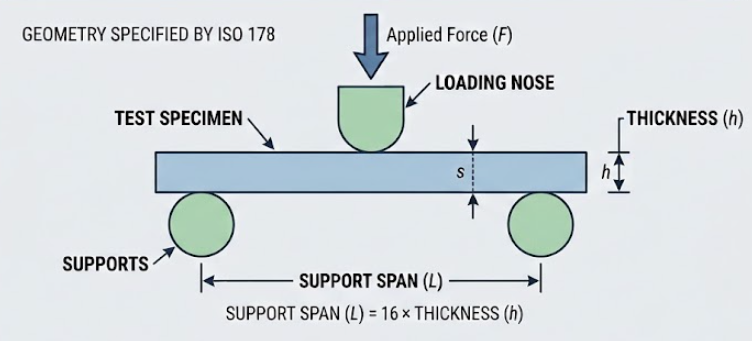
Despite its simple layout, bending creates a complex combination of forces inside the material at the same time:
- Compression (Top Surface): As the bar bends downward, the top surface is squeezed together.
- Tension (Bottom Surface): The bottom surface stretches outward. This is usually where micro-cracks start and cause the material to fail or snap.
- Shear (Internal Core): Horizontal sliding forces act along the middle layer of the bar as the top and bottom pull in opposite directions.
Key Results: What Does ISO 178 Measure?
By recording how much force is applied and how far the material bends, the test produces a few core measurements:
- Flexural Modulus (Stiffness): Measures how well the plastic resists bending when a small load is applied. A higher modulus means a stiffer material (e.g. acrylic or polycarbonate), while a lower modulus means a more flexible material (like polyethylene).
- Flexural Strength: The maximum stress the material can withstand before it snaps, yields, or permanently deforms.
- Flexural Strain at Break: The strain of the outer edge of the specimen before breaking or reaching the standard 3.5% strain limit (a standard stopping point for materials that bend significantly without fracture).
Performing the Test: Labthink C610M Auto Tensile Tester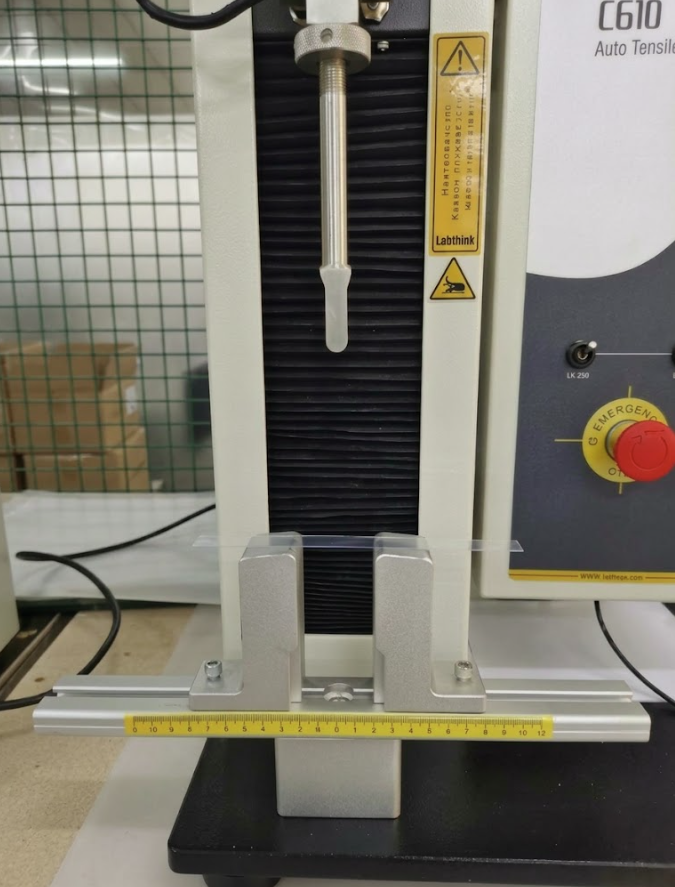
While dedicated bending rigs exist, modern quality control laboratories often rely on multi-functional Testing Machines that can handle multiple testing needs on one platform.
The Labthink C610M Auto Tensile Tester is built for this purpose. Beyond standard tensile, peeling, and tearing tests for soft packaging and films, the C610M can easily be configured with custom 3-point bending fixtures to execute ISO 178 tests.
Why It Works Well for Flexural Testing
- High-Precision Force Control: The instrument is equipped with optional precision load cells and delivers force measurement accuracy within ±0.5%, capturing subtle changes during the initial bending phase.
- Smooth & Accurate Motion: It features a precision ball screw drive and servo control system, delivering precise speed control (0 to 500 mm/min) required for standard modulus measurements.
- Versatile & User-Friendly: The tester can easily switch between pneumatic tensile grips and 3-point bend fixtures. Ten independent test modes are available, including tensile test, peel test, tearing test, heat seal test, fixed-elongation tensile test, puncture test of rubber closures, and puncture retention-force test.
Summary
Whether evaluating raw polymer batches, inspecting incoming raw materials, or comparing structural plastics, the ISO 178 three-point bend test provides a simple, standardized method to characterize material stiffness and strength under bending loads.