
Overview
Accurate measurement of water vapor permeability is vital to ensuring product shelf life, preserving pharmaceuticals, and evaluating the barrier performance of flexible packaging materials. Among dynamic instrumental testing techniques, the infrared (IR) detection sensor method is one of the most widely adopted industrial standards globally due to its broad measurement range, rapid testing throughput, and excellent reproducibility.
International standard ISO15106-2 (Plastics — Film and sheeting — Determination of waterpower transmission rate — Part 2: Infrared detection sensor method) and North American standard ASTMF1249 (Standard Test Method for Water Vapor Transmission Rate Through Plastic Film and Sheeting Using a Modulated Infrared Sensor) govern the operational parameters and instrument design for this testing method.
Technical Principle
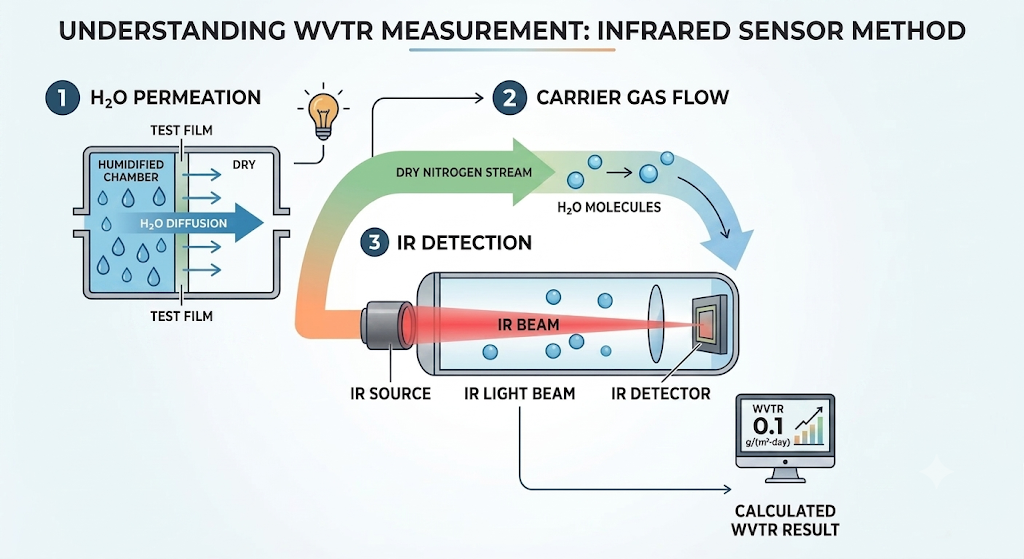
The infrared detection method operates under an equal-pressure (isostatic) carrier gas flow system. A flat specimen is clamped into a test cell, dividing the chamber into two distinct sides:
- Dry / Sweep Chamber: Swept continuously by a regulated flow of dry nitrogen carrier gas (N2).
- Controlled-Humidity Chamber: Maintained at a controlled relative humidity (90% RH or 100% RH ) via distilled water or humidified gas mixture.
Permeation & Optical Detection Mechanism
As water vapor molecules diffuse through the specimen matrix into the dry chamber, they are immediately picked up by the dry nitrogen stream and carried directly into the infrared sensor cell.
- Infrared Absorption: Water vapor molecules exhibit specific absorption bands in the infrared spectrum. The optical detection system utilizes an infrared source, a narrow-band optical filter, and a sensitive IR detector.
- Signal Generation: The intensity of infrared radiation reaching the detector decreases proportionally as water vapor concentration in the carrier gas increases.
Because the electrical response is proportional to the concentration of water vapor in the optical cell, the instrument calculates the exact Water Vapor Transmission Rate (WVTR) in g/(m2·day) . Since infrared sensors detect concentration optical absorption directly, periodic calibration using certified standard reference films (with known WVTR values) is required to ensure quantitative accuracy.
Standard Comparison: ISO 15106-2 vs. ASTM F1249
Selecting the appropriate standard and sensor technology depends heavily on the barrier level of the material undertest and laboratory compliance mandates.
Characteristic / Parameter | ISO 15106-2 / GB/T 26253 | ASTM F1249 |
Detection Method | Infrared (IR) Sensor Method | Modulated Infrared (IR) Sensor |
Measurement Mechanism | Optical IR Absorption | Optical Modulated IR Absorption |
Calibration Requirement | Standard Reference Film Calibration | Standard Reference Film Calibration |
Primary Test Range | to 1000 g/(m2·day) | to 1000 g/(m2 ·day) |
Typical Test Duration | Short to Moderate (High throughput) | Short to Moderate (High throughput) |
Harmonized Standards | GB/T 26253, JIS K 7129-2 | ISO 15106-2 |
Key Testing Requirements & Operation Parameters
To maintain strict compliance and high repeatability under ISO 15106-2 and ASTM F1249, the following test conditions must be precisely regulated:
- Temperature Stability: Test chambers are typically controlled to 23.0 °C. Temperature fluctuations must be kept within ±0.1°C , as gas diffusion rates are highly sensitive to thermal variation.
- Humidity Control: Humidity on the challenge side is established via liquid water reservoirs or saturated salt solutions. The carrier gas stream must be fully dried prior to entering the cell to establish a stable zero baseline.
- System Calibration: Calibration must be performed under identical temperature, humidity, and flow rate conditions as actual test specimens, using certified reference materials traceable to national standards institutes.
- Carrier Gas Purity: High-purity dry nitrogen gas (≥99.999% purity) is recommended to prevent baseline noise and ensure optimal IR signal-to-noise ratios.
Primary Applications
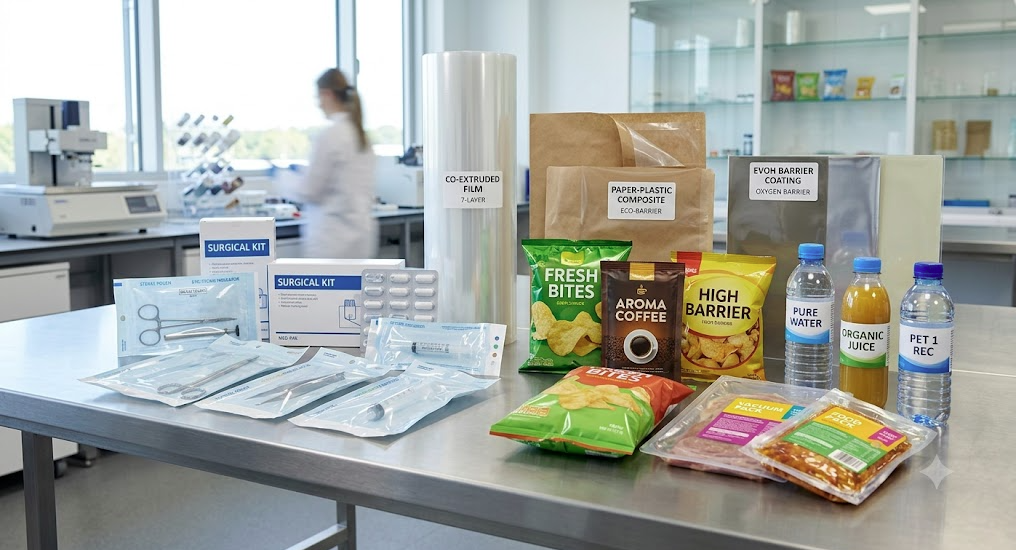
- Food Packaging Materials: Single-layer and multi-layer flexible films, polyolefin films (PE, PP), PET bottles, and laminates where fast turnaround times and high testing throughput are needed.
- Medical & Healthcare Packaging: Sterilization pouches, lidding materials, and protective film barriers requiring compliance with ISO 11607 packaging validation frameworks.
- Industrial & Technical Laminates: Co-extruded plastic sheets, functional barrier coatings, and paper-plastic composites.
Labthink C306H Water Vapor Transmission Rate Test System is designed and manufactured based on infrared sensor method conforming to ASTM F1249 and ISO15106-2. It is applicable to determination of water vapor permeability of plastic films, sheeting, paper, packages and other relative packaging materials in food, pharmaceutical, medical apparatus, consumer goods, photovoltaic and electronic industries.