
In the tobacco manufacturing industry, paper substrates and outer packaging materials are far more than passive enclosures—they are active factors of product performance, smoke delivery, sensory preservation, and regulatory compliance.
From the burning characteristics dictated by cigarette paper permeability to the volatile solvent retention limits governed by packaging regulations, comprehensive quality control (QC) testing is a necessity for manufacturers and packaging converters alike.

Key Parameters in Tobacco Paper & Packaging Testing
Ensuring consistency across high-speed production lines requires rigorous testing across multiple key physical and chemical metrics:
- Air Permeability: Directly governs air dilution, burn rate, static burn rate, and carbon monoxide (CO) yields. Inconsistent paper porosity leads to non-uniform smoke strength and customer dissatisfaction.
- Barrier & Permeation Properties (OTR / WVTR): Outer pack wrappers and carton overwraps protect tobacco products from moisture loss, off-odors, and oxygen degradation, preserving freshness throughout storage and shelf-life.
- Solvent Residue & Migration: Residual solvents from printing inks or adhesives can contaminate the product. Precision gas chromatography ensures compliance with strict volatile organic compound (VOC) limits.
- Mechanical & Tensile Strength: Tipping papers and plug wraps endure significant mechanical tension during high-speed rolling; high tensile performance prevents costly line jams.
Is the Cigarette paper Permeability Test the same as that of other air permeability tests? The basic physical principle—measuring gas flow under a controlled pressure gradient—is the same as other air permeability tests, but the specific execution and standardized metrics for cigarette paper are uniquely specialized.
How does the Cigarette paper Permeability Test differ from other air permeability tests?
Cigarette paper permeability is highly standardized worldwide around the specific dynamics of a burning cigarette:
|
Precision Porosity Testing: Introducing the Labthink C180M Air Permeability Tester
Air permeability testing of specialty tobacco papers—such as cigarette tipping paper, filter plug wrap, and tipping base paper—requires high accuracy, rapid throughput, and complete compliance with international standards such as ISO 2965, YC/T 172, GB/T 12655, and JJG (Tobacco)-1998
The Labthink C180M Air Permeability Tester is specifically engineered to meet these demanding laboratory standards using the differential pressure method.
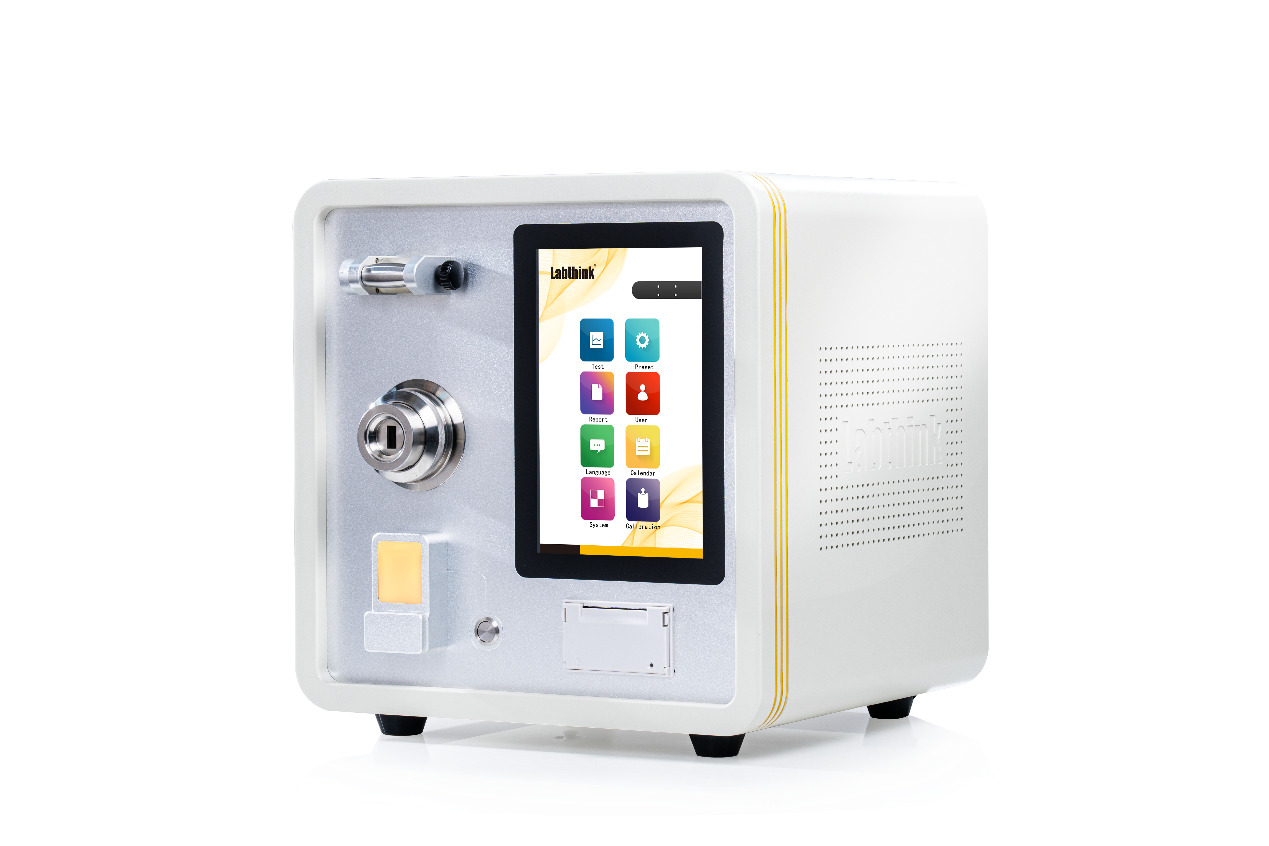
Feature / Metric | Specification / Capability |
Measurement Principle | Differential Pressure Method |
Test Applications | Cigarette paper, filter plug wrap, filter joining paper, oriented permeable zones |
Flow Measurement Range | 0 – 20,000 CORESTA units 0 – 40,000 mL/min |
Resolution | 0.1 CORESTA |
Pressure Range | 0~2 kPa |
Measurement Interval | 30~999 mm |
Compliance Standards | ISO 2965, YC/T 172, GB/T 12655, JJG (Tobacco)-1998 |
Compliance & Traceability | Optional 21 CFR Part 11 and GMP computer system support |
Core Advantages of the C180M for Laboratory Workflow
- Rapid High-Throughput Operation: With a single-point measurement speed under 10 seconds, the C180M allows technicians to execute high-density testing routines without creating bottlenecks in production workflows.
- Fully Automatic & Safe Pneumatic Clamping: Eliminates operator variance by ensuring consistent sealing pressure across a test area. The integrated anti-clamping safety design protects lab personnel during continuous operation.
- Advanced Pressure Control: Features an imported pressure-regulating module to maintain uniform differential pressure ( with accuracy), ensuring reproducible testing results.
- Automated Data Analysis: Powered by an intuitive industrial touch screen, the system automatically calculates maximum, minimum, average values, standard deviations, and coefficients of variation (CV).
Complete Quality Assurance Across the Packaging Line
Labthink C180M delivers class-leading performance for air permeability and CORESTA porosity measurements, nevertheless a holistic tobacco QA program pairs permeability testing with comprehensive packaging analysis:
- Overall Migration & Evaporation Residue Testers: Automatically evaluates total non-volatile substance migration from packaging materials, inks, and adhesives under varying food/tobacco simulant conditions to satisfy food contact safety limits (such as GB 4806, EU 10/2011, and YQ standard requirements).
- Gas Chromatography (GC-MS): Evaluates solvent residue, phthalates, and photoinitiator migration on printed pack wrappers.
- Permeability Analyzers (WVTR / OTR): Guarantees barrier integrity against moisture loss and oxygen ingress for cartons and pouches.
- Tensile & Seal Testers: Evaluates heat-seal strength, coefficient of friction (COF), and burst strength for automated high-speed packing operations.
By integrating dedicated analyticalinstruments like the C180M into routine quality assurance, manufacturers maintain complete process control, safeguard product integrity, and ensure strict compliance with global industry standards.