
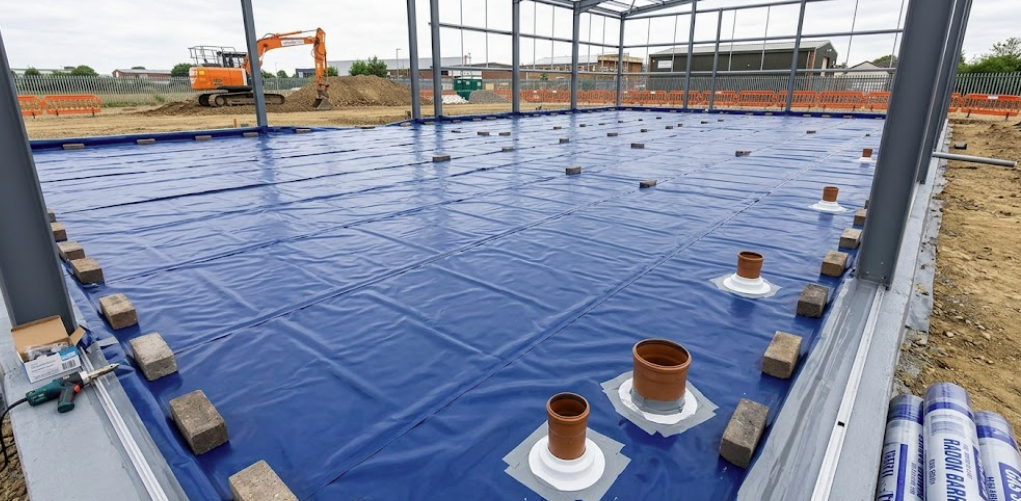
Before barrier films or geomembrane sheets are deployed in civil infrastructure, environmental containment systems, or brownfield redevelopments, they must undergo rigorous laboratory testing to verify their performance. Among these evaluations, the determination of the Methane Gas Transmission Rate (MGTR) is critical. This test ensures that geomembranes can effectively restrict the migration of hazardous sub-surface gases into structures or the atmosphere.
To ensure a reliable benchmark, materials are tested under established international frameworks, specifically ASTM D1434 (Standard Test Method for Determining Gas Permeability Characteristics of Plastic Film and Sheeting) or ISO 15105-1 (Plastics — Film and sheeting — Determination of gas-transmission rate — Part 1: Differential-pressure method).
The Methodology: Differential Pressure Test Principle
Both ASTM D1434 (specifically Method V, the manometric method) and ISO 15105-1 utilize a differential pressure mechanism to evaluate gas permeability. The test systematically isolates a specimen of the barrier material to measure the volume of gas passing through it over time under controlled conditions.
1. Test Cell Configuration
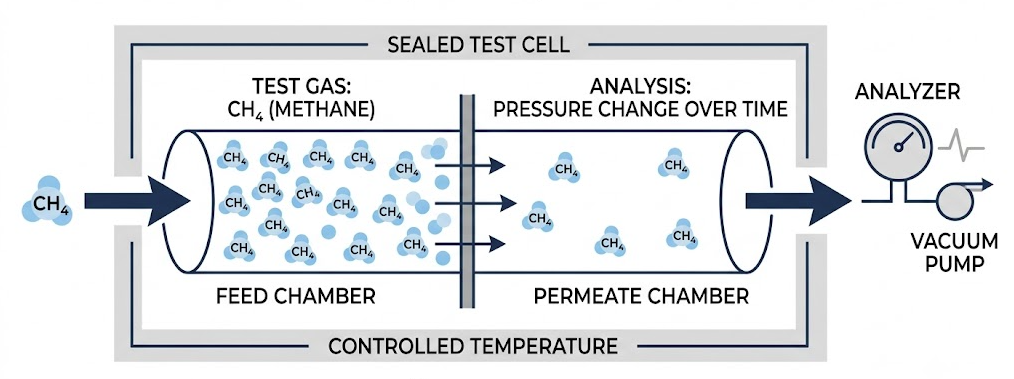
The core mechanism relies on a sealed test cell split into two distinct chambers separated by the test specimen:
? High-Pressure Chamber (Feed Side): This chamber is charged with pure methane (CH4) gas at a precise, constant pressure.
? Low-Pressure Chamber (Permeate Side): This chamber is initially evacuated under a high vacuum to reduce the internal pressure to near zero. It is equipped with an ultra-precise pressure transducer or an integrated capillary manometer to monitor minuscule changes in pressure.
2. Test Execution and Data Collection
Once the system achieves thermal and pressure equilibrium inside an environmental chamber, the test begins:
1. Methane gas is introduced into the high-pressure chamber, establishing a severe partial pressure differential across the material thickness.
2. Driven by this gradient, methane molecules dissolve into the upstream surface of the film, diffuse across its polymer matrix, and desorb from the downstream surface into the evacuated low-pressure chamber.
3. As methane accumulates in the low-pressure chamber, the internal pressure begins to rise. A data acquisition system continuously records this pressure increase over time .
 Mathematical Representation and Quantifying MGTR
The Methane Gas Transmission Rate is calculated based on the steady-state rate of pressure increase in the lower chamber. Using the ideal gas law and the physical parameters of the cell, the transmission rate is formalized as follows:
GTR = V / (A · R · T) × (dp / dt)
Where:
? GTR = Gas Transmission Rate
? V = Volume of the low-pressure chamber
? A = Active transmission area of the barrier specimen
? R = Universal gas constant
? T = Absolute temperature
? dp/dt = The steady-state rate of pressure change in the low-pressure chamber
To normalize this data across varying laboratory conditions and allow for accurate material comparisons, the value is divided by the pressure differential (ΔP) across the film, yielding the final value in ml/day·m2·atm.
Designated Test Equipment: Labthink Gas Permeability Tester
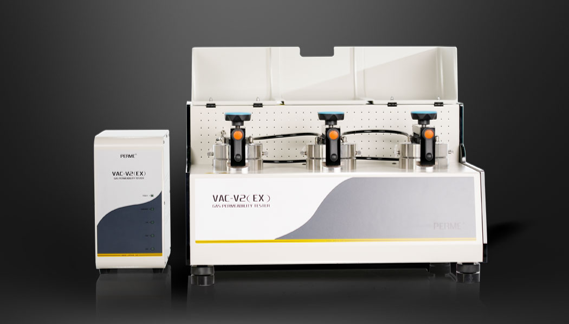
Labthink VAC-V2 (EX)-H is a professional laboratory instrument engineered specifically for evaluating the gas barrier properties of membranes and sheets. Built on the fundamental differential pressure method, the system is fully compliant with leading international test standards including ISO 15105-1 and ASTM D1434.
The equipment features unique Hazardous Gas Compatibility. It is uniquely built with an advanced split control system that completely separates the tester mainframe from the control module. This design ensures total operational safety when testing highly toxic, flammable, or explosive gases like methane (CH4) or hydrogen (H2).
 Why MGTR Testing is Crucial
Evaluating a barrier film's resistance to methane transmission is not merely a regulatory checkbox; it is a critical safety and environmental imperative for several key reasons:
Explosion and Vapor Intrusion Risk Mitigation: Methane is a highly volatile, flammable gas with a Lower Explosive Limit (LEL) of 5% and an Upper Explosive Limit (UEL) of 15% by volume in air. In brownfield sites (such as decommissioned landfills, former gas stations, or industrial zones), subsurface methane can migrate laterally and pool beneath concrete structural slabs. Without an authenticated barrier film showing an MGTR below certain limit, methane can permeate the foundation, leading to dangerous accumulation inside enclosed spaces and introducing severe flash-fire or explosion hazards.
Climate Change and Greenhouse Gas Containment
Methane is a potent greenhouse gas with a Global Warming Potential (GWP) roughly 28 to 36 times greater than carbon dioxide (CO2) over a 100-year timescale. When barrier liners are installed in municipal solid waste landfills or biogas collection facilities, lab-verified low MGTR sheeting prevents fugitive methane emissions from leaking into the atmosphere, directly supporting global carbon reduction initiatives.
Quality Control and Structural Integrity Assurance
Not all polymers block small hydrocarbon molecules equally. Minor alterations in polymer density, resin purity, crystalline structure, or multi-layer co-extrusion uniformity can profoundly alter gas permeability. Testing via ASTM D1434 or ISO 15105-1 acts as a definitive quality assurance mechanism, proving that the manufactured sheets meet engineering specifications prior to logistics and field deployment.
 Comparative Overview of Standards
Parameter / Aspect | ASTM D1434 (Method V) | ISO 15105-1 |
Primary Mechanism | Manometric / Differential Pressure | Pressure Sensor / Barometric |
Typical Metric Unit | cm3 / m2 · 24h · atm | mol / m2 · s · Pa (or converted to ml / m2 · day· atm) |
Calibration Focus | Strict volume determination of cell | Precision tracking of sensor voltage/ pressure changes |
Industry Target | Commonly cited in North American engineering | Widely mandated in European and international specs |
Ultimately, requiring barrier films to pass standardized laboratory testing ensures that the deployed environmental safety measures function perfectly under real-world pressures, protecting structures, human life, and the global atmosphere from sub-surface gas hazards
References & Standards:
? ASTM D1434 - Standard Test Method for Determining Gas Permeability Characteristics of Plastic Film and Sheeting.
? ISO 15105-1 - Plastics — Film and sheeting — Determination of gas-transmission rate — Part 1: Differential-pressure methods.