
Residue on Ignition (ROI) is a widely used analytical method to determine the amount of inorganic impurities in a material. It is commonly applied in pharmaceutical, chemical, and food-related industries where material purity is critical.
In simple terms, ROI measures the non-combustible residue remaining after a sample is subjected to high-temperature ignition.
Why ROI Matters
Residue on Ignition is widely used for:
- Pharmaceutical quality control (e.g., USP <281>)
- Raw material purity evaluation
- Contamination monitoring
- Process consistency verification
It provides a reliable indicator of total inorganic residue, even though it does not identify specific components.
The Principle: Loss on Ignition
ROI is based on gravimetric analysis, also known as loss-on-ignition.
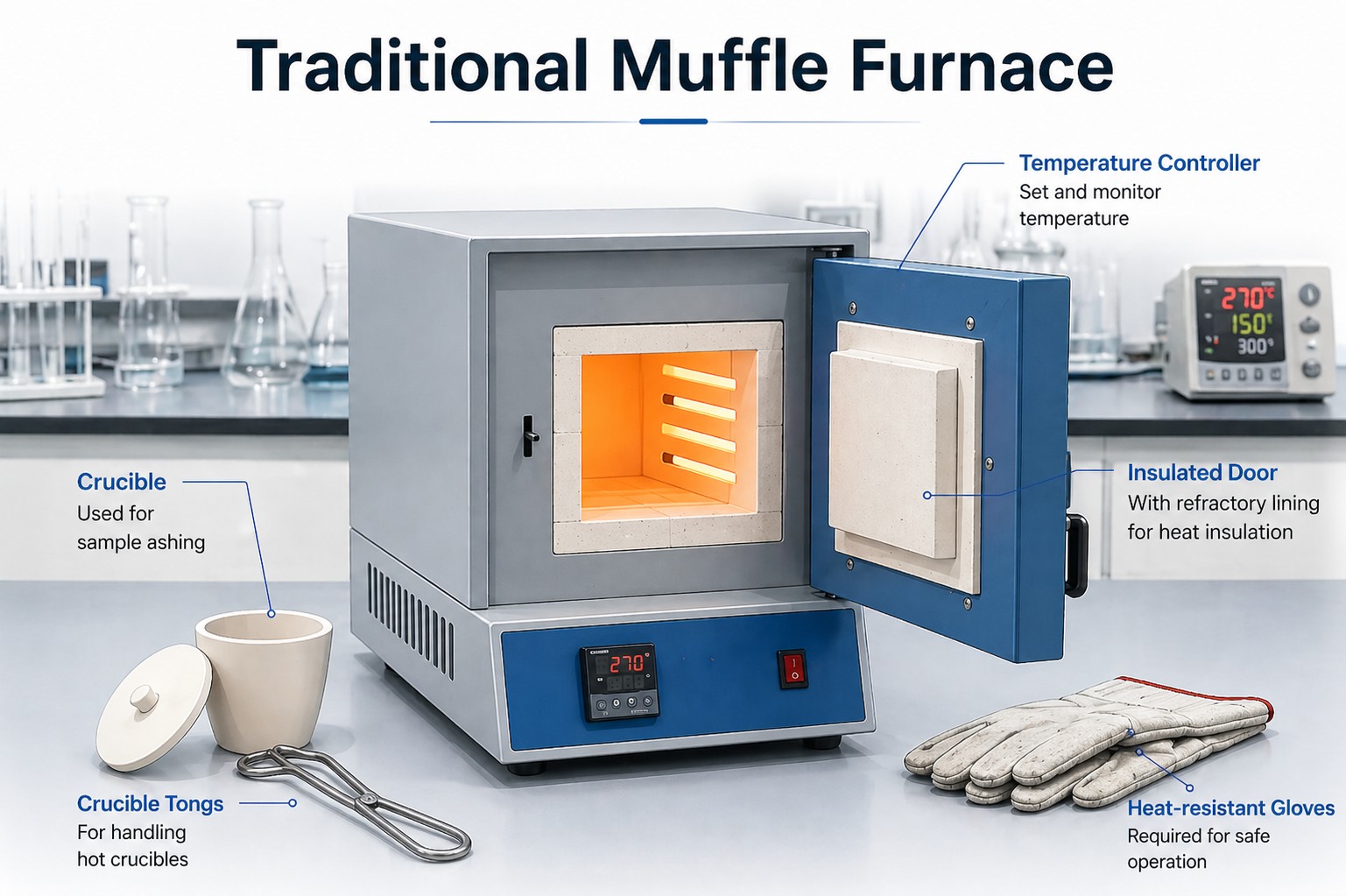
When a sample is heated in a muffle furnace (typically 500°C–800°C):
- Organic substances decompose and volatilize
- Carbon-based materials are burned off
- Inorganic residues remain as ash
The remaining residue represents the total inorganic content.
Step-by-Step Procedure
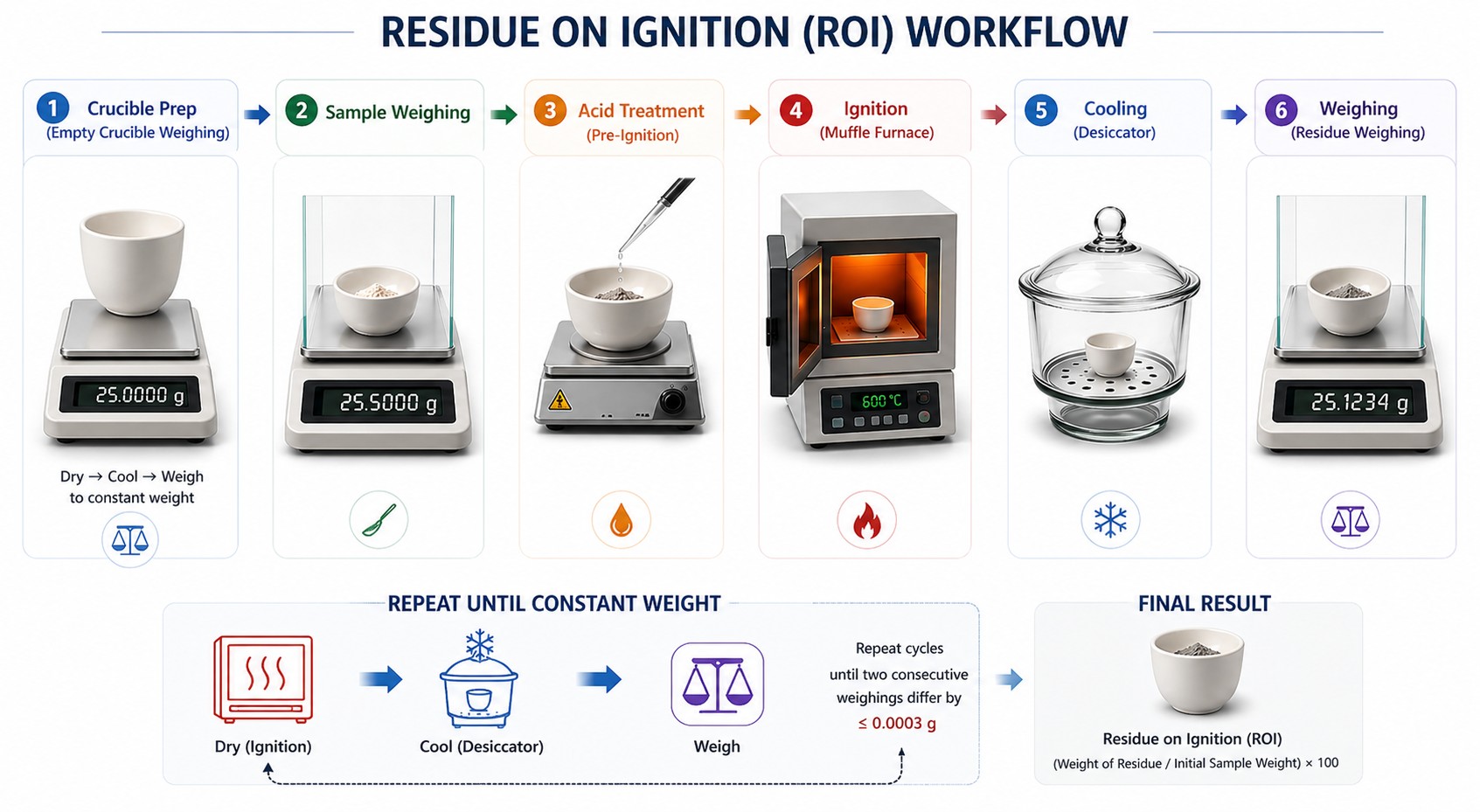
1. Empty Crucible to Constant Weight
Clean the empty crucible, then ignite (ash) it at high temperature.
Cool in a desiccator and weigh.
Repeat the cycle of ignition → cooling → weighing until a constant weight is achieved.
2. Sample Addition & Pre-Treatment
Add a defined amount of sample into the crucible and record the weight.
Gently heat to carbonize (char) the sample before full ignition.
This step helps to:
- Prevent sample loss due to splashing or rapid evaporation
- Avoid overflow caused by foaming (e.g., sugars, proteins, starch)
- Ensure complete ashing by avoiding carbon encapsulation
3. Sulfuric Acid Treatment
Add a small amount of sulfuric acid (typically 0.5–1 mL) to moisten the sample.
This step helps to:
- Promote complete carbonization
- Convert inorganic components into stable sulfates
- Oxidize residual carbon into CO? at high temperature
Heat gently until fumes are no longer evolved.
4. Ignition (Ashing)
Place the crucible in a muffle furnace and heat gradually to the target temperature.
During this process:
- Organic matter is completely decomposed
- Residual carbon is removed
- A stable inorganic residue (ash) is formed
5. Cooling, Weighing & Constant Weight
Transfer the crucible to a desiccator and allow it to cool.
Weigh the residue.
Repeat the cycle of ignition → cooling → weighinguntil constant weight is achieved.
6. Calculation
Residue on Ignition (ROI, %) is calculated as:

From Manual Workflow to Automation
Traditional ROI testing involves multiple manual steps—such as acid addition, controlled heating, sample transfer, and repeated weighing to reach constant weight—which can introduce variability, increase safety risks, and require intensive labor.
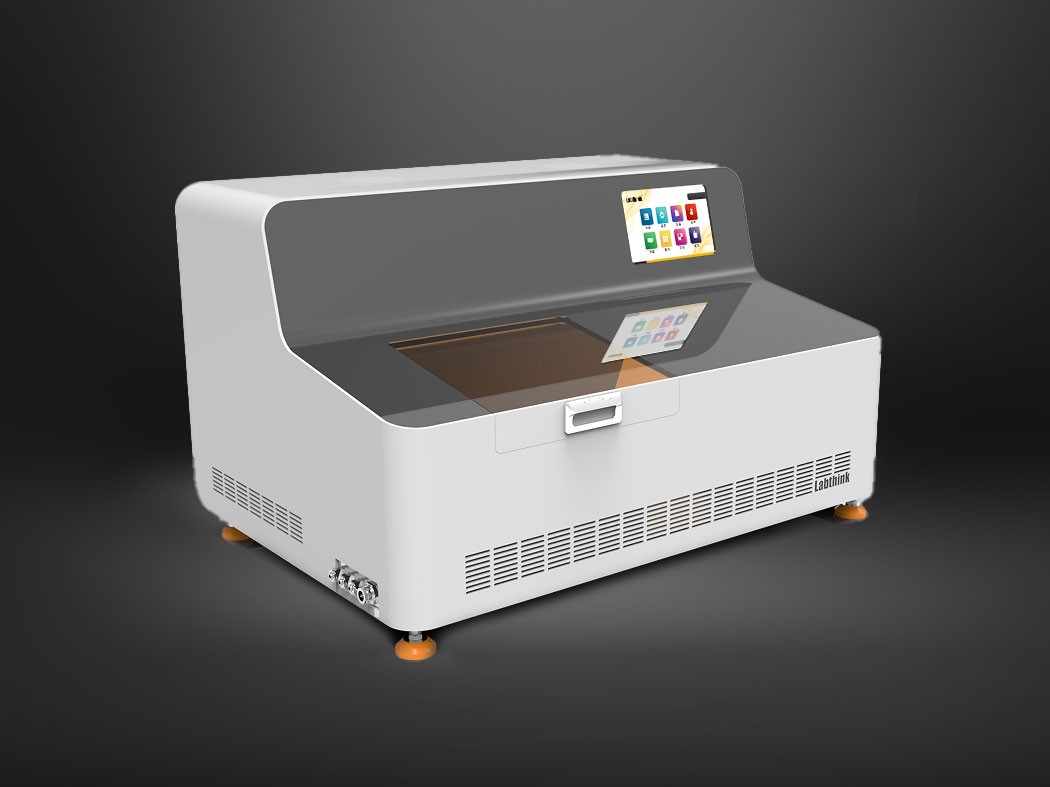
Labthink modern automated systems, such as advanced ROI analyzers, address the limitations of manual workflows by enabling intelligent automation, high-throughput testing, reduced labor dependency, and enhanced operational safety.
For example, the C860M Integrated Residue on Ignition Testing System automates the workflow and helps laboratories achieve automation with reliable results, especially in high-throughput or regulated environments.
Final Thoughts
Traditional ROI testing relies heavily on manual operation and repeated procedures, making it inefficient and difficult to scale.
- High labor dependency – requires continuous operator involvement
- Multiple manual steps – acid addition, heating, transfer, and weighing
- Constant weight requirement – repeated cycles increase time and complexity
- Operator-dependent results – prone to variability
- Safety risks – handling high-temperature crucibles and corrosive acids
- Limited throughput – difficult to handle large sample volumes
Modern automated systems simplify the workflow and significantly improve laboratory performance.
- Fully automated process – from acid addition to constant weight determination
- Higher throughput – process more samples in less time
- Reduced labor – minimal manual intervention required
- Improved consistency – less human-induced variation
- Enhanced safety – no direct contact with heat or chemicals
- Data traceability – automatic recording and tracking
- One-click operation – intelligent control with predefined methods