
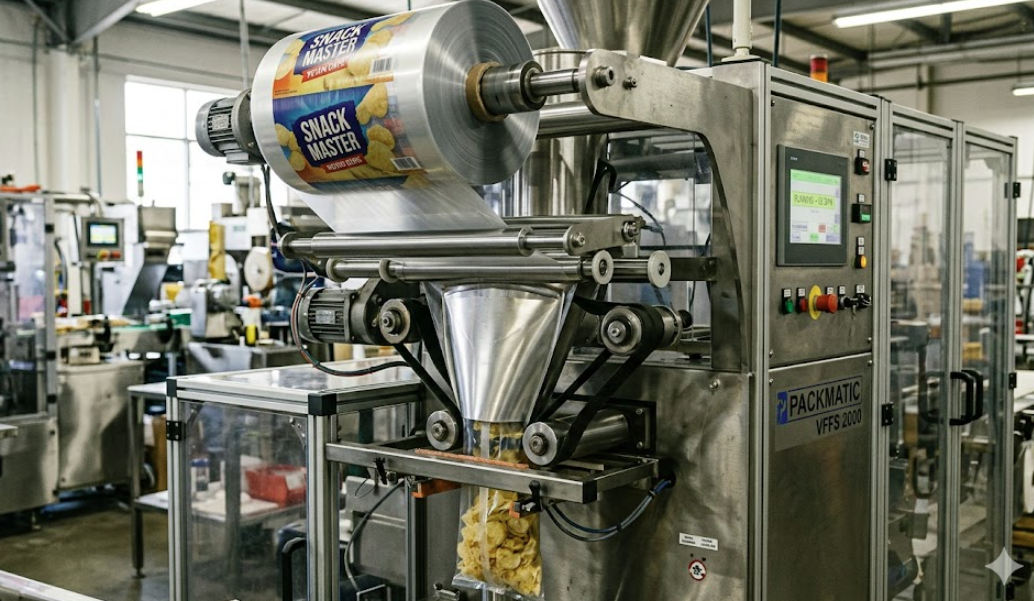
In the high-speed world of Vertical Form Fill Seal (VFFS) packaging, the difference between a perfect production run and a morning of wasted film often comes down to a single invisible variable: the Coefficient of Friction (COF). Whether your film is stuttering over the forming collar or slipping through the pull belts, understanding the interplay between static and kinetic friction is the key to maintaining machine uptime.
Section 1: Static vs. Kinetic COF in Packaging
To troubleshoot machine failures, we must first distinguish between the two phases of friction.
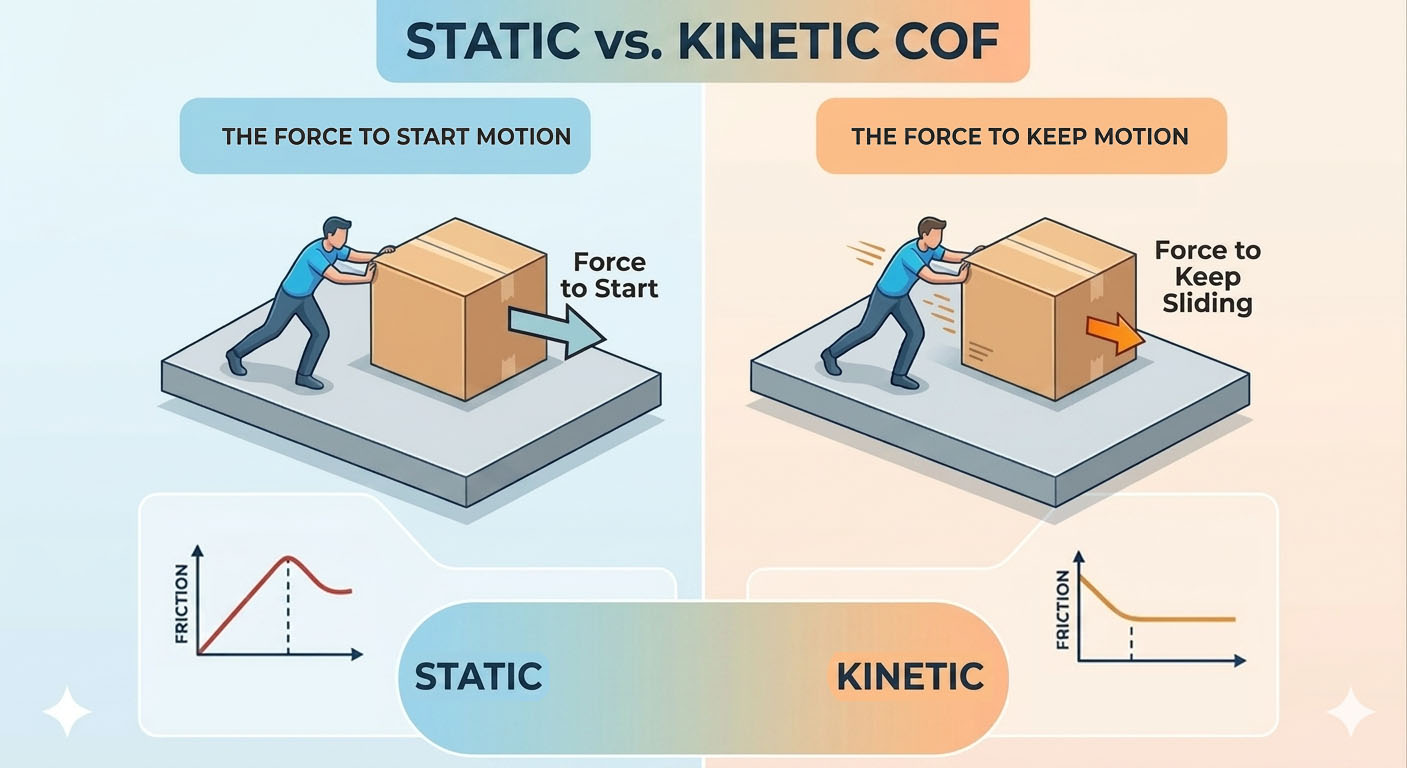
- Static COF (The Starting Force): This is the peak force required to initiate movement between two resting surfaces. In VFFS, this occurs when a heavy film roll begins to unwind after a pause, or when the film rests against the metal forming collar before the pull cycle begins.
- Kinetic COF (The Sliding Force): Also known as dynamic friction, this is the continuous force required to maintain movement at a steady, constant speed once the film is already in motion.
- The Interlock Factor: Scientifically, static friction is inherently higher than kinetic friction. This is because resting surfaces have time to "microscopically interlock." In packaging, the ultimate goal is to manage the transition from "stop" to "go" smoothly, avoiding the jerky motions that lead to material fatigue.
Section 2: Why COF Imbalance Triggers Machine Failure
A VFFS machine is a delicate balancing act of grip and glide. When the COF is out of spec, the mechanical process breaks down in two specific areas:
- The Pull Belts (When COF is Too Low): Pull belts rely on friction to grab the outer layer of the film and move it downward. If the film is too slick (low COF), the belts slip. This results in inconsistent "short bags," registration faults where the graphics don't align, and poor seals because the film isn't positioned correctly in the jaws.
- The Forming Collar (When COF is Too High): The inside layer of the film must glide over the rigid metal forming tube. If the friction here is too high, the film "stutters"—a phenomenon known as stick-slip. This causes the material to stretch, warps the printed graphics, and can even cause the film to tear.
The Golden Rule: Successful packaging requires a differential. You need a high enough outer COF for the belts to grip, and a low enough inner COF to slide over the metal machinery.
Section 3: The Role of Slip Additives
Film manufacturers don't leave friction to chance; they use chemistry to control it.
- The "Bloom" Effect: Extruders use slip additives. These molecules are mixed into the polymer but are designed to "bloom" or migrate to the surface over time, creating a microscopic lubricating layer that lowers the COF.
- The Variable Nature of Friction: Because these additives are migratory, they are sensitive to the environment. Temperature fluctuations in a warehouse, storage duration, and even the tension of the roll can alter how these additives migrate. A film that tested perfectly at the factory may have a completely different COF by the time it reaches a hot production floor.
Section 4: Testing COF to Prevent Downtime
How do you catch a friction issue before it ruins a production shift? By generating a friction curve through standardized laboratory testing (such as ASTMD1894).
A weighted sled covered in the test film is pulled across a stationary surface (representing the machine collar or another film layer). The resulting data provides a map of both the static peak and the kinetic average.
The Labthink Solution
To ensure these measurements are precise, Labthink provides industry-leading COF testers designed specifically for the flexible packaging industry. Models like MXD-02 Coefficient of Friction Tester and the C620H Friction / Peel Tester automate the sled movement to eliminate human error, providing high-resolution data that identifies even the slightest"stick-slip" tendencies. With Labthink technology, manufacturers can simulate production speeds and temperatures to ensure the film will perform exactly as expected on the VFFS line.

Conclusion
The Coefficient of Friction is more than just a number on a spec sheet; it is the pulse of your packaging line. By balancing the "grip" required by pull belts with the"glide" required by the forming collar, and by monitoring the behavior of slip additives through rigorous testing, you can eliminate the most common causes of VFFS downtime.
Labthink is committed to helping you achieve this balance. With a global reputation for excellence in permeation and physical property testing, Labthink’s instruments provide the data-driven confidence you need to keep your film moving smoothly from the roll to the retail shelf.