
In industries where product integrity is paramount—from pharmaceuticals and high-barrier foods to sophisticated electronics—packaging materials are not merely containers; they are engineered environmental barriers. For B2Bprocurement specialists, R&D engineers, and QA managers, selecting the right material is a high-stakes decision driven by one crucial metric: the Water Vapor Transmission Rate (WVTR).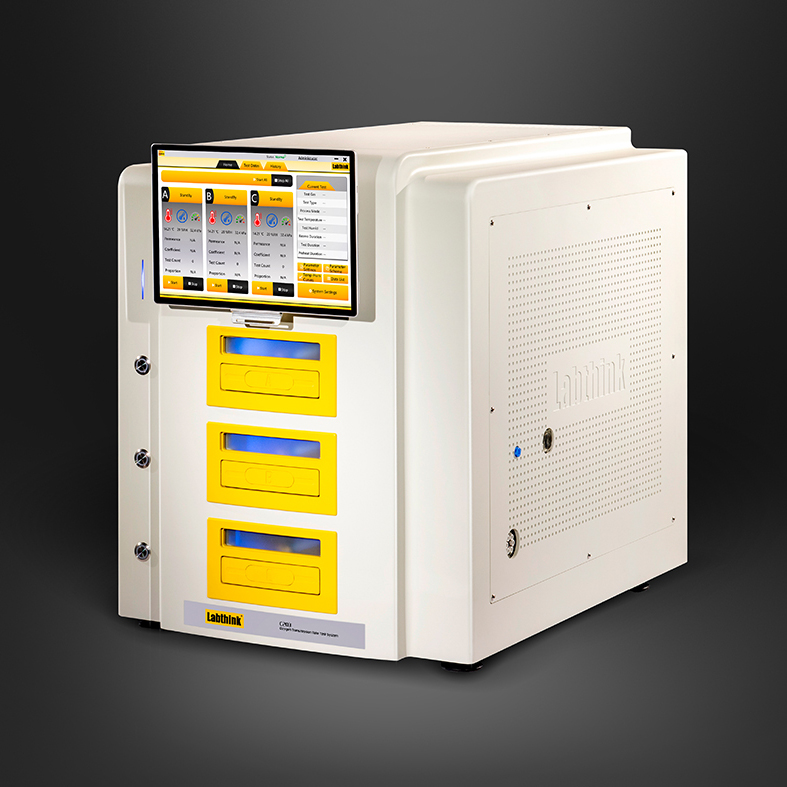
Understanding the WVTR principle and utilizing precise measurement tools is the only definitive way to bridge a product's stability requirements with a material’s performance capabilities. This article explains how the water vapor transmission rate testing principle dictates material selection and how advanced equipment, specifically the Labthink C303H Water Vapor Transmission Rate Test System, provides the necessary data for strategic packaging decisions.
Defining the WVTR Principle
The WVTR principle quantifies the rate at which water vapor permeates through agiven packaging material under specific environmental conditions. It is expressed as the mass of water vapor passing through a unit area of the material over a unit time, typically measured in grams per square meter per 24hours.
The driving force behind this transmission is the partial pressure differential of water vapor between the two sides of the material. By maintaining a high humidity on one side of the test specimen and a low, controlled humidity on the other, we simulate the harsh real-world conditions that a product's packaging must withstand.
The outcome of the water vapor transmission test directly informs the material’s barrier property:
Low WVTR: Indicates a superior barrier (e.g., metalized films, PVDC, or specific foil laminates). These materials are essential for highly sensitive or moisture-absorbent products (like hygroscopic APIs or specialized medical devices).
High WVTR: Indicates a poor barrier (e.g., standard paper or certain breathable fabrics). These are used when moisture exchange is either required or irrelevant to product stability.
The Problem with Simple Screening
Relying on generic material specifications or simplified screening methods is insufficient for modern B2B quality standards. The WVTR of a material is not a fixed number; it is highly dependent on both temperature and humidity. A material that performs adequately in a temperate zone may fail disastrously in a tropical climate. This complexity mandates the use of highly accurate, standardized water vapor transmission test systems.
Advanced Testing: The Labthink C303H
To meet the rigorous demands of pharmaceutical, food, and chemical packaging, we require instrumentation that delivers speed, precision, and adherence to international standards. Labthink addresses this need with the C303H Water Vapor Transmission Rate Test System.
TheC303H is based on infrared sensor technology, a highly sophisticated technique detailed in standards like ASTM F1249 and ISO15106-2. This method is the preferred choice for measuring very low transmission rates, making it indispensable for evaluating high-barrier materials commonly used in sensitive applications.
LabthinkC303H Water Vapor Transmission Rate Test System Key Technical Specifications
TheC303H provides the precision necessary for critical material validation:
Ultra-Low Detection Limit: The system features a remarkably low minimum test rate, typically down to 0.005g/(m2·24h). This capability allows us to confidently test and validate the integrity of ultra-high barrier films, such as pharmaceutical blister pack foils and specialized aseptic packaging.
Broad Measurement Range: The maximum test rate can be extended up to 2000 g/(m2·24h)(MASK area 1cm2), meaning the instrument is versatile enough to measure from high-barrier foils to medium-barrier poly films, providing a comprehensive solution for diverse material portfolios.
High-Throughput Testing: The system is equipped with three independent test chambers, enabling us to test three different samples simultaneously and produce three independent data sets. This parallel testing significantly accelerates research and quality control timelines.
PrecisionEnvironmental Control: The system boasts automatic and precise control over thetest environment, with a temperature control range typically from 15 C to 50Cand humidity control from 5%RH to 90%RH. This allows for the exact simulationof product storage conditions globally.
Standard Compliance: Utilizing the coulometric method ensures strict compliance with major standards like ASTM F1249 and ISO 15106-2, guaranteeing that data generated by Labthink is verifiable and accepted worldwide.
WVTR as the Guide for Material Selection
The data provided by the C303H acts as a critical filter in the material selection process:
Product Stability Assessment: The first step is determining the Maximum Allowable Moisture Permeation (MAMP) for the drug or component. If a product degrades when moisture content exceeds 0.5%, we calculate the necessary WVTR barrier required to maintain stability over the product’s intended two-year shelf life.
Material Screening and Cost Optimization: Knowing the required WVTR value allows us to screen hundreds of candidate materials. High-performance, low-WVTR materials—like certain aluminum foils or specialized co-extruded films—are often more expensive. By using the precision data from the C303H, we can select the least expensive material that just meets the MAMP requirement, optimizing cost without risking product quality.
Predictive Modeling: The precise data feeds into predictive stability software, allowing packaging engineers to model the material’s performance under worst-case scenarios, thereby preventing costly real-world failures and providing solid justification for shelf-life claims.
In conclusion
The principle of water vapor transmission rate testing moves packaging selection from an educated guess to an engineering certainty. For Labthink,providing the precise tools to execute this test is key to ensuring that our partners meet their regulatory mandates and protect their valuable products throughout the supply chain.