
We often observe that material selection decisions are made based on mechanical strength or cost, while gas barrier performance is sometimes underestimated. However, gas transmission rate (GTR) is a fundamental parameter that directly determines how well a material can protect products from environmental gas exposure. At Labthink, we specialize in delivering advanced gas permeation test solutions that help industries accurately evaluate gas permeability behavior across a wide range of materials. Through precise measurement systems like our VAC-V2 (EX) Gas Permeability Tester, we support engineers in understanding not just whether a material works—but how and why it performs under real conditions.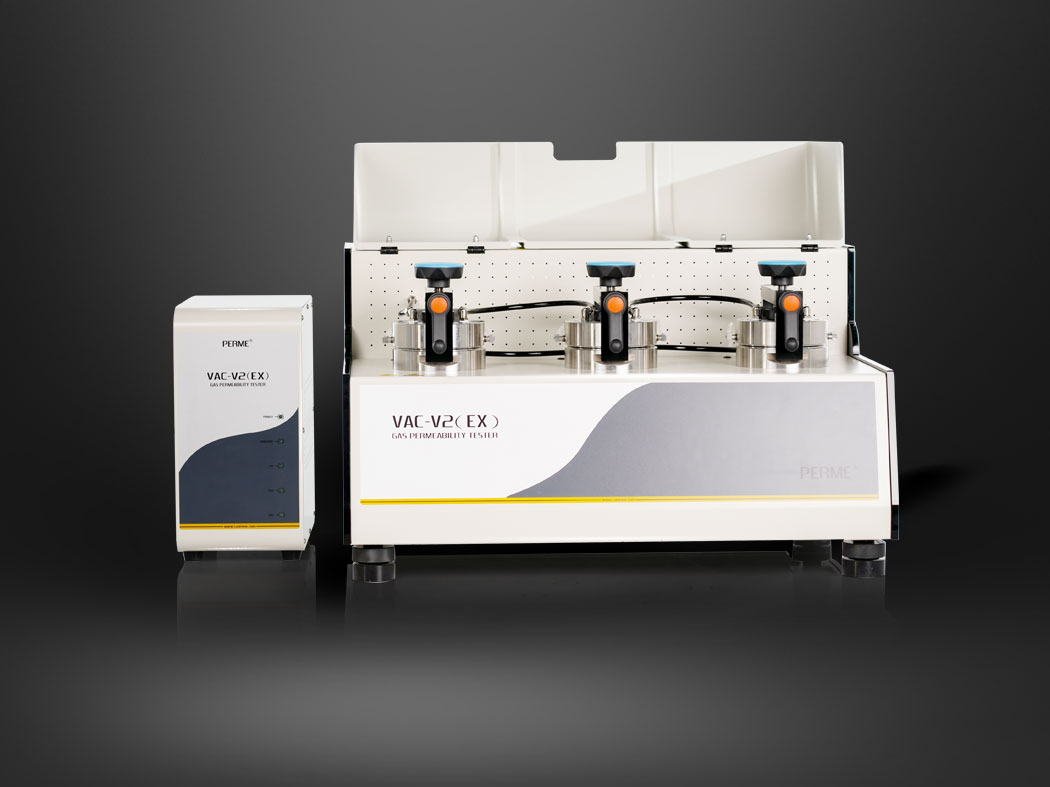
Defining Gas Transmission Rate: Meaning, Units, and Measurement
Gas transmission rate refers to the amount of gas that passes through a unit area of material over a specific period under controlled temperature and pressure conditions. It is typically expressed in units such as cm3/(m2·day·atm). In practical terms, GTR describes the barrier efficiency of a material against gas penetration. When we conduct a gas permeation test, we are evaluating how gases interact with a material’s structure, including how they dissolve, diffuse, and pass through it. Alongside gas transmission rate, parameters such as permeability coefficient, solubility coefficient, and diffusion coefficient help us fully describe gas permeability behavior in different materials like plastic films, composite films, and aluminum foils.
What Is Being Tested in Gas Permeability Evaluation?
In gas permeability testing, we are fundamentally measuring a material’s resistance to molecular gas movement. This includes common gases as well as hazardous ones such as toxic, flammable, or explosive substances. The key question we address is: how easily can gas molecules pass through a barrier under specific conditions? Using Labthink systems, engineers can simulate real-world environments across varied temperatures to understand true material behavior. The VAC-V2 (EX) Gas Permeability Tester is designed based on the differential pressure method, enabling accurate measurement of gas transmission rate while ensuring safety during testing of high-risk gases.
Why Gas Transmission Rate Matters for Material Engineers
For material engineers, gas transmission rate is not just a laboratory figure—it is a predictive performance indicator. In industries such as food packaging, pharmaceuticals, electronics, and energy storage, even minor variations in gas permeability can lead to oxidation, degradation, or safety hazards. That is why gas permeation test data is essential for making informed material selections. Understanding gas permeability allows engineers to design products with longer shelf life, improved safety, and higher reliability. Without accurate GTR data, material performance in real-world applications becomes uncertain and risk-prone.
Advanced Testing Technology Supporting Safer Material Design
At Labthink, we design instruments like the VAC-V2 (EX) Gas Permeability Tester to ensure precise, safe, and efficient evaluation of gas transmission rate. Its advanced split control system separates the mainframe from the control module, enhancing operational safety during testing of hazardous gases. The system is also TüV certified and supports simultaneous testing of three samples, improving efficiency and consistency. By measuring gas transmission rate, permeability coefficient, solubility coefficient, and diffusion coefficient in a single platform, we provide a comprehensive understanding of gas permeability behavior for modern engineering needs.
Turning GTR Insight into Better Engineering Decisions
We believe that gas transmission rate should be treated as a core engineering parameter rather than a secondary specification. Through accurate gas permeation test methods, material engineers can better predict long-term performance and avoid critical failures. At Labthink, we remain committed to advancing gas permeability testing technologies that transform complex material behavior into actionable engineering insights, helping industries design safer and more reliable products.