
For Labthink, as professionals in the flexible packaging and materials science industries, understanding and accurately measuring barrier properties is not just a quality control measure—it is fundamental to our products' viability, shelf life, and brand reputation. The packaging barrier property dictates how well our material can resist the permeation of external and internal substances, maintaining the integrity and quality of the enclosed product.
Asflexible films become the material of choice across the food, pharmaceutical, and cosmetic sectors, the scientific precision of our barrier performance analysis is critical. This guide provides a detailed look into the core barrier properties and the testing solutions we use to meet rigorous industry standards.
1. Understanding Our Role in Packaging Barrier Properties
A packaging barrier functions as a shield, preventing the ingress or egress of specific compounds that can compromise a product's stability. In the flexible packaging we develop—including films, foils, and laminates—barrier performance is primarily defined by the transmission rate of various gases and moisture.
The wrong barrier choice can lead to significant issues for our clients, such as food spoilage due to oxidation, moisture absorption causing caking, or the loss of volatile aromas that define a product's flavor profile. Our role is to provide the precision test instruments necessary for clients to define this crucial barrier performance quantitatively.
2. Key Transmission Rate Measurements in Our Package Testing Services
The performance of any flexible packaging material we test is predominantly evaluated using two crucial metrics, which serve as the foundation for our entire discipline of package testing services:
Oxygen Transmission Rate (OTR): This measures the steady-state rate at which oxygen gas passes through a film under specified conditions of temperature and relative humidity. Oxygen is a primary contributor to oxidation and rancidity, making a low OTR essential for oxygen-sensitive products.
Water Vapor Transmission Rate (WVTR): This measures the rate at which water vapor permeates through a material under controlled temperature and humidity conditions. Moisture control is paramount for maintaining texture and extending shelf life.
Beyond these core properties, we also consider the transmission rate of carbon dioxide, critical for modified atmosphere packaging (MAP), and the transmission of aromas or organic solvents.
3. The Precision Behind Our Barrier Property Testing
Achieving a high-performance barrier begins not with the material, but with the packaging barrier property tester itself. For our experienced quality and R&D teams, the equipment we use must offer validated accuracy and the capability to handle a diverse range of flexible substrates, from single-layer films to multi-layer composite films and various laminates.
For over 35 years, we at Labthink have focused on instruments and package testing services tailored to the flexible packaging industry, developing advanced analytical solutions to meet these precise demands. Our entire catalog is built around providing highly sensitive paper and packaging material testing Instruments that meet or exceed global testing standards.
4. Introducing Our C403H Combination OTR/WVTR Analyzer
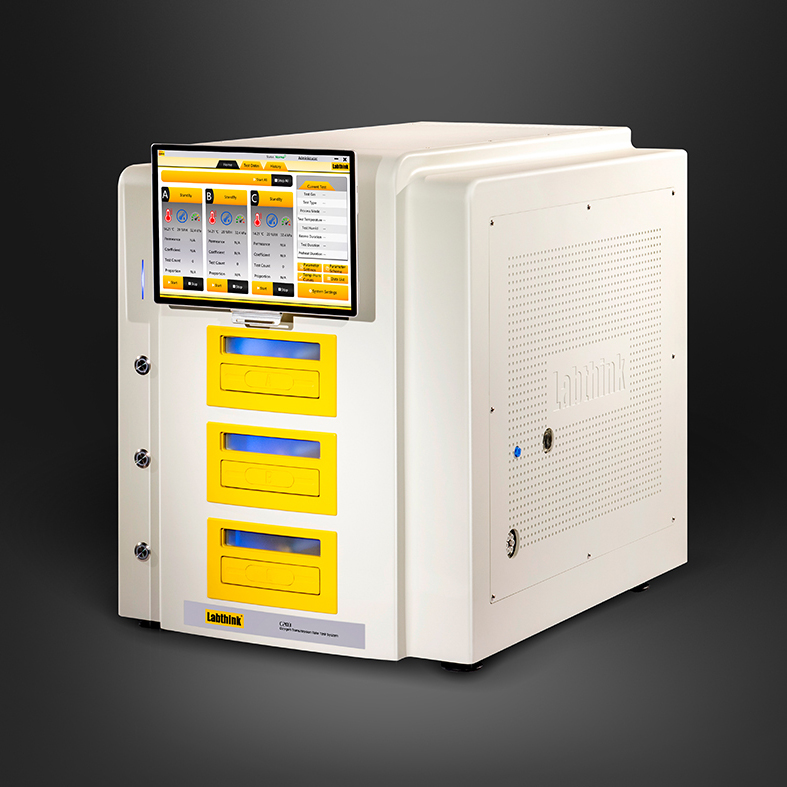
TheC403H Oxygen/Water Vapor Transmission Rate Test System is a key instrument in our product line, designed to provide high-precision, simultaneous testing of OTR and WVTR on flexible packaging materials. It is a prime example of equipment we build for high-level R&D and quality assurance environments.
This instrument features several critical technical specifications that appeal to the experienced material professional. For OTR analysis, we utilize the Coulometric sensor method, adhering to standards like ASTM D3985 and ISO 15106-2. Simultaneously, for WVTR, we employ the Infrared sensor method. This reliance on distinct, validated sensor technologies confirms the unit's high precision capability, allowing us to test both high- and ultra-low barrier materials with reliability.
TheC403H is a multi-function unit, capable of performing both key tests within the same system, streamlining our testing workflow. Furthermore, its design allows for a customizable single or multi-station configuration, offering flexibility sample throughput. The instrument’s temperature control is highly stable, which is crucial for accurately simulating various storage and transport conditions. This combined functionality makes it a benchmark among paper and packaging material testing Instruments.
5. The Labthink Advantage: Core Selling Points for Experienced Clients
The decision to invest in a specialized packaging barrier property tester is driven by the need for reliable, quantitative data. The C403H exemplifies several of Labthink’s core selling points relevant to experienced technical teams:
High Quality and Long Lifespan: Our durable design and reliable sensor technology are engineered for sustained operation in demanding laboratory environments, offering a long-term testing solution.
High Precision and Repeatability: Our use of validated, specialized sensors(Coulometric for OTR and Infrared for WVTR) ensures test results are reliable and consistently reproducible, which is critical for compliance validation and material certification. This focus on precision test instruments is paramount.
Multi-Function and Customizable: The system’s combined testing capability and configuration options allow our customers to maximize efficiency and tailor the equipment to specific research or quality control demands.
6. The Financial and Regulatory Impact of Accurate Testing
In the B2B flexible packaging space, we know that barrier failure is directly linked to financial loss and regulatory non-compliance. Accurate testing allows our clients to make informed, high-stakes business decisions:
Optimize Material Costs: By precisely identifying the minimum barrier properties required for a product's target shelf life, we help engineers avoid over-engineering the packaging, leading to material and production savings.
Mitigate Product Recall Risk: Consistent and traceable data from our reliable equipment helps demonstrate due diligence against standards like ASTM and ISO, preventing costly product recalls associated with spoilage or contamination.
Validate New Structures: With the industry's shift toward sustainable and compostable films, precise instruments are necessary for us to validate the performance of novel, multi-layer, or bio-based packaging structures against traditional materials. Investing in the correct paper and packaging material testing Instruments is an investment in risk mitigation.
Conclusion
The decision to invest in a specialized barrier tester is driven by the need for accurate data that supports mission-critical material development and quality assurance efforts. For enterprises that rely on data-driven compliance and material innovation, partnering with a company like us provides the necessary assurance that their package testing services and precision test instruments align with global technical benchmarks.